CREATE TABLE
    dbo.view_me
(
    id int NOT NULL
);
GO

CREATE VIEW
    dbo.viewed
AS
SELECT
    vm.*
FROM dbo.view_me AS vm WITH(READCOMMITTED);
GO

SELECT
    v.*
FROM dbo.viewed AS v WITH(NOLOCK);
GO
Msg 4138, Level 16, State 1, Line 22
Conflicting locking hints are specified for table “dbo.view_me”. This may be caused by a conflicting hint specified for a view.
Thanks for reading!
Going Further
If this is the kind of SQL Server stuff you love learning about, you’ll love my training. Blog readers get 25% off the Everything Bundle — over 100 hours of performance tuning content. Need hands-on help? I offer consulting engagements from targeted investigations to ongoing retainers. Want a quick sanity check before committing to a full engagement? Schedule a call — no commitment required.
One of them fixes a bug with view creation when you use a custom schema. The rest are minor tweaks and fixes that you (hopefully won’t notice one bit), but make me feel a little bit better about the state of the code.
I took a look through SQL Server 2022’s new Extended Events, and haven’t seen anything in there that would warrant the amount of work it takes to add something new just yet. Maybe at some point, I suppose.
Some folks had asked about adding lightweight query profiling etc. as an option, but it still doesn’t return the kind of details that make it useful for query tuning.
I mean, I guess if you believe in memes it’s okay, but… Maybe you should stop that.
Thanks for reading!
Going Further
If this is the kind of SQL Server stuff you love learning about, you’ll love my training. Blog readers get 25% off the Everything Bundle — over 100 hours of performance tuning content. Need hands-on help? I offer consulting engagements from targeted investigations to ongoing retainers. Want a quick sanity check before committing to a full engagement? Schedule a call — no commitment required.
I haven’t run into a bug with this thing in just about… Well, ever. This procedure has been pretty solid.
As I use it though, especially in front of clients, I find myself wanting some additional data points all in one place. With this release, I’ve added a few small things.
Total physical memory in the server (not just max server memory)
CPU details (NUMA nodes, schedulers; if they’re off line, etc.)
A debug mode for the dynamic SQL
The CPU details column is an XML clickable that will look something like this:
If this is the kind of SQL Server stuff you love learning about, you’ll love my training. Blog readers get 25% off the Everything Bundle — over 100 hours of performance tuning content. Need hands-on help? I offer consulting engagements from targeted investigations to ongoing retainers. Want a quick sanity check before committing to a full engagement? Schedule a call — no commitment required.
This is just a quick post to list out new wait stats in SQL Server 2022. How many will be useful, time will tell.
Some waits that I think might be interesting:
CXSYNC_CONSUMER (Currently in Azure)
CXSYNC_PORT (Currently in Azure)
PARALLEL_DB_SEEDING_SEMAPHORE
PLPGSQL
It looks like maybe automatic seeding for Availability Groups is getting the ability to process multiple databases at once, and we’re getting some parallel query waits that used to be Azure only.
I’m really scratching my head about PLPGSQL though. That’s the “programming language” that Postgres supports, which is sort of like what Oracle supports.
If this is the kind of SQL Server stuff you love learning about, you’ll love my training. Blog readers get 25% off the Everything Bundle — over 100 hours of performance tuning content. Need hands-on help? I offer consulting engagements from targeted investigations to ongoing retainers. Want a quick sanity check before committing to a full engagement? Schedule a call — no commitment required.
Add the ability to search by query hash, plan hash, and SQL handle
The SQL Server 2022 stuff isn’t important just yet, but… Hey, maybe someday.
The new search functionality is really important though, at least for how I use sp_QuickieStore much of the time. Often, you’ll find hashes and handles in other parts of the database:
Plan cache
Deadlock XML
Blocked process report
Query plans
There’s still no good way for you to search Query Store by anything. Not plan or query id, not query text, not object names. Nothing.
Don’t worry, I’m here for you.
Some other minor updates were to:
Improve the help section
Improve code comments throughout
Remove the filter to only show successful executions (sometimes you need to find queries that timed out or something)
If you filter on any hash or handle, I’ll display that in the final output so they’re easy to identify
Replace TRY_CONVERT with TRY_CAST, which throws errors in fewer circumstances
That’s about all the stuff you need to know about. Aside from that, all my changes were slight logical errors or plumbing to implement the new features.
Thanks for reading!
Going Further
If this is the kind of SQL Server stuff you love learning about, you’ll love my training. Blog readers get 25% off the Everything Bundle — over 100 hours of performance tuning content. Need hands-on help? I offer consulting engagements from targeted investigations to ongoing retainers. Want a quick sanity check before committing to a full engagement? Schedule a call — no commitment required.
USE StackOverflow2013;
EXEC dbo.DropIndexes;
SET NOCOUNT ON;
DBCC FREEPROCCACHE;
GO


CREATE INDEX
   chunk
ON dbo.Posts
    (OwnerUserId, Score DESC)
INCLUDE
    (CreationDate, LastActivityDate)
WITH
    (MAXDOP = 8, SORT_IN_TEMPDB = ON, DATA_COMPRESSION = PAGE);
GO

CREATE OR ALTER VIEW
    dbo.PushyPaul
WITH SCHEMABINDING
AS
    SELECT
        p.OwnerUserId,
        p.Score,
        p.CreationDate,
        p.LastActivityDate,
        PostRank =
            DENSE_RANK() OVER
            (
               PARTITION BY
                  p.OwnerUserId
               ORDER BY
                  p.Score DESC
            )
    FROM dbo.Posts AS p;
GO

SELECT
    p.*
FROM dbo.PushyPaul AS p
WHERE p.OwnerUserId = 22656;
GO

CREATE OR ALTER PROCEDURE
    dbo.StinkyPete
(
    @UserId int
)
AS
SET NOCOUNT, XACT_ABORT ON;
BEGIN
    SELECT
        p.*
    FROM dbo.PushyPaul AS p
    WHERE p.OwnerUserId = @UserId;
END;
GO

EXEC dbo.StinkyPete
    @UserId = 22656;


/*Start Here*/

ALTER DATABASE
    StackOverflow2013
SET PARAMETERIZATION SIMPLE;

DBCC TRACEOFF
(
    4199,
    -1
);

ALTER DATABASE SCOPED CONFIGURATION
    SET QUERY_OPTIMIZER_HOTFIXES = OFF;


SELECT
    p.*
FROM dbo.PushyPaul AS p
WHERE p.OwnerUserId = 22656
AND   1 = (SELECT 1); /*Avoid trivial plan/simple parameterization*/


/*Let's cause a problem!*/
ALTER DATABASE
    StackOverflow2013
SET PARAMETERIZATION FORCED;

SELECT
    p.*
FROM dbo.PushyPaul AS p
WHERE p.OwnerUserId = 22656
AND   1 = (SELECT 1); /*Avoid trivial plan/simple parameterization*/


/*Can we fix the problem?*/
DBCC TRACEON
(
    4199,
    -1
);


SELECT
    p.*
FROM dbo.PushyPaul AS p
WHERE p.OwnerUserId = 22656
AND   1 = (SELECT 1); /*Avoid trivial plan/simple parameterization*/


/*That's kinda weird...*/
DBCC FREEPROCCACHE;


SELECT
    p.*
FROM dbo.PushyPaul AS p
WHERE p.OwnerUserId = 22656
AND   1 = (SELECT 1); /*Avoid trivial plan/simple parameterization*/


/*Turn Down Service*/
DBCC TRACEOFF
(
    4199,
    -1
);

SELECT
    p.*
FROM dbo.PushyPaul AS p
WHERE p.OwnerUserId = 22656
AND   1 = (SELECT 1); /*Avoid trivial plan/simple parameterization*/


/*Okay then.*/


/*I'm different.*/
ALTER DATABASE SCOPED CONFIGURATION
    SET QUERY_OPTIMIZER_HOTFIXES = ON;


SELECT
    p.*
FROM dbo.PushyPaul AS p
WHERE p.OwnerUserId = 22656
AND   1 = (SELECT 1); /*Avoid trivial plan/simple parameterization*/


/*Cleanup*/
ALTER DATABASE
    StackOverflow2013
SET PARAMETERIZATION SIMPLE;

ALTER DATABASE SCOPED CONFIGURATION
    SET QUERY_OPTIMIZER_HOTFIXES = OFF;

DBCC TRACEOFF
(
    4199,
    -1
);
Video Summary
In this video, I delve into a specific issue in Microsoft SQL Server 2017 CU30, where the documentation left out crucial details about how parameterized queries can affect query plans. I explain that running parameterized queries skips the cell on sequence project rule, preventing pushdown and causing full index scans instead of seeks. To demonstrate this, I walk through setting up an appropriate index and running both literal and parameterized queries to illustrate the difference in execution plans. The video also covers how trace flag 4199 affects query optimization but does not clear the plan cache, while the database scope configuration method does. This discrepancy highlights the importance of understanding these nuances for effective query tuning and optimization.
Full Transcript
Alright, I apologize if the lighting is a little bit weird. It’s a, there’s kind of a weird weather day out here, and the light is very bright and white, and then I turned on my ring light to try and compensate for that. I’m not sure how that’s gonna look, I’m not sure how that’s gonna go, but anyway. I, I, I need to follow up yesterday’s video about the, the, the Sell On Seek Project issue in Microsoft SQL Server 2017 CU30, because the, the, it turns out that the, the documentation in, in the, in this, in the cumulative update, shockingly, was, left, left some stuff to be desired, left, left some crucial elements out. Now.
This is still just saying the same thing that it said yesterday. In Microsoft SQL Server 2017, running parameterized query skips the cell on sequence project rule. Therefore, pushdown does not occur.
If you click on the little link there, nothing happens. It just takes you back to this, basically takes you to the bookmark of this issue. So that’s fun.
And that leaves out, like I said, a very crucial detail. Now, I’m going to walk back. Screw you, Mac Toolbar. Who does that?
Macs are the worst. If anyone ever tries to convince you to switch over to a Mac, burn them. Burn them like the witch they are.
Or warlock they are. Whatever it is. I don’t know. Anyway. Yesterday, we ran through this demo where we created an index that very well suits both the query that we’re going to run.
You know, owner user ID score, right? We got owner user ID and score and the windowing function. And creation date and last activity date in the select list. And later, we’re going to run some queries that filter on owner user ID with an equality predicate.
So this should be a totally seekable thing. So yesterday’s video, I showed you that if we use a literal value and we run that query, we get a nice seek. The literal value gets pushed down past the sequence project operator, seeks into the index.
But when we parameterize the query, that no longer happens. We scan the whole index, do the whole dense rank windowing function thing, and then filter out later. All right.
So we’re going to start here today. And we’re going to make sure that we are starting in the right place with none of this stuff going on. We want to make sure that none of these things are in effect when we run this. So I’m going to run this query, which is the same query that we ran yesterday, essentially.
But the reason I want to run it this way is with that one equals select one is to avoid SQL Server’s cost-based optimizer, trying to use a trivial plan or use simple parameterization on our query. And when we do that, we get this thing is a literal value.
And we can see that, you know, we have a sequence project, right? This is the SEQPRJ, part of that rule that gets skipped and all that. We got a couple of segments that I don’t really care about.
But then more importantly, we have the index seek into, again, our hero chunk. Anyway, let’s mess with that a little bit. Let’s cause a problem here.
So yesterday, I used a stored procedure to show you that a parameterized query would behave differently, even with the cumulative update installed, right? So let’s set parameterization to forced for this database.
And remember, under a simple parameterization, you pass in a literal value. It’s kind of up to the optimizer whether, you know, the trivial plan, simple parameterization kicks in and you actually get a simple parameterized query.
Under forced parameterization, under most circumstances, SQL Server will be like, oh, well, cool, we can throw this right at you, right? Turn that into a parameter magically for you.
All right. So now with parameterization force turned on, let’s run this thing. And this is where things sort of start to fall over, right? Because with forced parameterization turned on, we now have a query plan that looks like this.
I didn’t mean to have that tool tip pop up. Apologize there. But you’ll notice that this looks kind of funny, right?
Everything has these little spaces and stuff between and everything’s lowercase is God intended. So if anyone out there is watching and perhaps uses capitalized table aliases, perhaps this is, you know, a pretty good sign that that’s the wrong way to do things.
Just saying. But anyway, we have owner user ID equals at zero. And this is one of my favorite parts of simple parameterization is and at one equals select one.
So I’m not really sure where they came up with that. It’s just kind of cute for me. But anyway, the query plan looks a little bit different because we got this stuff up here to deal with that.
We actually have a startup expression predicate on the literal value one equaling the at one parameter. But, you know, that’s neither here nor there. The important part is down here where we now have that index scan that we saw yesterday.
Right? And that takes a couple seconds. And over here we have a filter operator. And that filter operator is where we figure out where that parameter value that we passed in gets applied.
Now, yesterday we had the stored procedure where it was called at user ID. Today the predicate is just going to be that at zero that we saw in the query text up here. Right?
That at zero. Okay. Okay. So, you know, when I was looking into it yesterday after I recorded the original video, something that threw me off and I thought was pretty funny was that, you know, a lot of these things are hidden behind trace flags. And now a very common one that a lot of these fixes get hidden behind is trace flag 4199.
4199 has been around, I don’t know, since like SQL Server. I think, I want to say 2008, but it might even be 2005. I refuse to try to find that literature at this point.
But 4199 hides a lot of the optimizer hot fixes that end up in SQL Server. So, this was like the first thing, like after I recorded yesterday’s video, I was like, okay, calm down. Send it yourself, Erik Darling.
Stop drinking. Well, that didn’t happen. But, so if you turn on this trace flag, something kind of funny happens at first. And that you turn on trace flag 4199 and you run the query again and you get the same query plan. All right.
And this might throw you off. All right. And why might this throw you off? Good question. I was just about to ask that. That was a great question. This is the next one that you answer in the video. So, the reason why you get the same query plan, this whole thing, is that turning on trace flag 4199, which enables optimizer hot fixes, doesn’t actually clear out the plan cache.
No, it does not. So, a trace flag that directly affects optimizer behavior does not clear out the plan cache. Why?
I don’t know. I’m going to pause for a moment. Hope I don’t make any mouth sounds with that. Do hate a mouth sound. But, let’s clear out the plan cache then.
Need a little pick me up there. Let’s clear out the plan cache and rerun this. My favorite characters ever is a rerun. But now, with trace flag 4199 enabled and a fresh plan generated for this query, we get the behavior that we would expect to see based on the documentation, which does not mention trace flag 4199. Out of the box with a little modification to the box there.
Tiny little difference. So, good, right? Sort of, I guess.
No one told you that. And that’s kind of depressing. But, let’s turn off trace flag 4199. Just to prove to you that that is the case, that 4199 does not do anything to the plan cache.
We turn that off, we’re actually still going to get the same query plan as last time, right? We get the seek plan again. So, that’s kind of annoying.
One thing that is different, and one thing that does clear out the plan cache and allow you to get the plan is to use the altered database scope configuration method of turning on optimizer hotfixes. Which is probably the preferred method, to be honest. Just because, you know, turning trace flags on and off is a little tricky.
You know, they don’t persevere restarts unless you, you know, set them at SQL Server startup. Or you have a startup store procedure run to flick those switches on. But, even with, like, stuff like trace flag 8048, you know, the startup procedure option isn’t quite as good because a bunch of other stuff gets initialized first.
So, anyway. Story for a different day. But, anyway.
So, you turn on optimizer hotfixes and all of it. And, you know, you will get the fresh plan and the plan cache and clear it out and get the seek plan and all that stuff. So, that’s sort of it for this one. If you want to see your parameters get pushed past the sequence project operator, you are going to need to enable trace flag 4199 and clear out the plan cache.
Or use the database scope configuration to set hotfixes on. So, moral of the story here. Well, I guess there’s maybe two or three of them.
We’ll see how many I think of as I start talking. One, Microsoft CU documentation is crap. Real bad.
Two, trace flag 4199 does not clear out the plan cache despite the fact that it directly affects the way the optimizer handles queries. Three, the database scope configuration for query optimizer hotfixes does clear out the plan cache. And, I guess, four, why the hell wouldn’t you make both of those things behave the same way?
Three, why wouldn’t a trace flag that changes optimizer behavior clear out the plan cache so that you can immediately see that optimizer behavior? That’s a little bit weird for me. I mean, I know, like, the database scope configuration thing, that cropped up around SQL Server 2016, I think.
So, we had, let’s see, like, probably three, four versions, major versions of SQL Server between, of trace flag 4199 not clearing out the plan cache. That’s, ain’t that cute as a boot. Anyway, I’m going to go finish this espresso, we’ll call it, and, I don’t know, wait five years for this video to render on my piece of crap Macintosh computer.
And, that’ll be, that’ll be my day. Just spend the day tending to the fire that, that occurs when, when I render a video. So, anyway, you all have a wonderful Saturday, or whatever day you end up watching this on.
I hope that, hope that you, hope that you are living your best lives. Thanks for watching.
Going Further
If this is the kind of SQL Server stuff you love learning about, you’ll love my training. Blog readers get 25% off the Everything Bundle — over 100 hours of performance tuning content. Need hands-on help? I offer consulting engagements from targeted investigations to ongoing retainers. Want a quick sanity check before committing to a full engagement? Schedule a call — no commitment required.
In the release notes for SQL Server 2017 CU30, there’s a note that it fixes a problem where parameters can’t be pushed passed Sequence Project operators:
“In Microsoft SQL Server 2017, running parameterized queries skips the SelOnSeqPrj rule. Therefore, pushdown does not occur.” But it doesn’t actually do that.
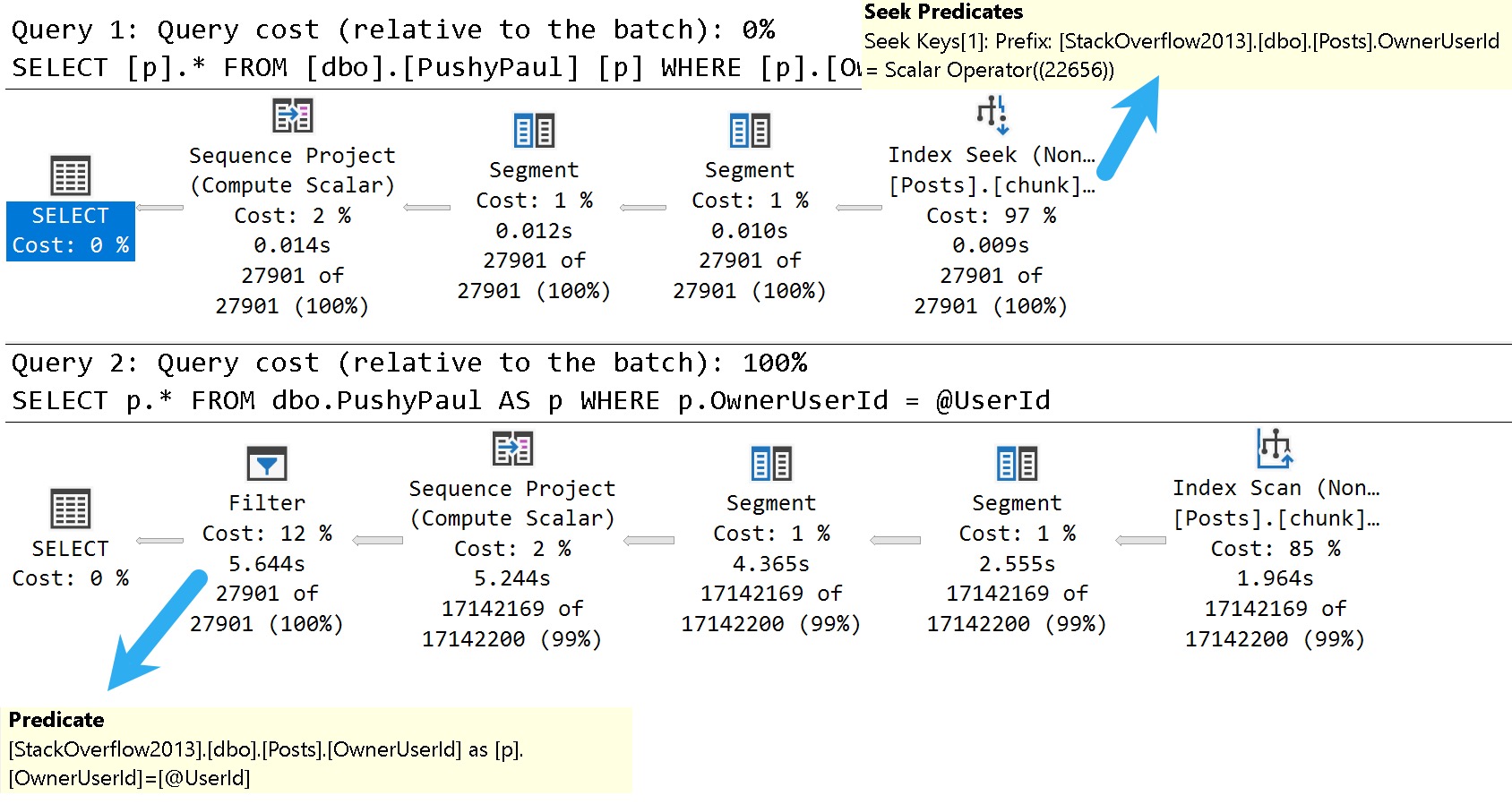
Here are the good and bad plans, comparing using a literal value vs. a parameterized value:
dunksville
In the plan with a literal value, the predicate is applied at the index seek, and the filtering is really quick.
In the plan with a parameterized value, the index is scanned, and applied at a filter way later in the query plan.
This is where the SelOnSeqPrj rule comes in: The parameter can’t be pushed past the Sequence Project operator like the literal value can.
Thanks for reading!
Video Summary
In this video, I delve into some of the known issues and updates in SQL Server 2017 CU30, focusing on one particular performance-related fix that caught my attention. Despite the title suggesting a discussion about 2000, we’re actually looking at modern SQL Server versions from 2022. I explore how running parameterized queries can sometimes skip certain seek optimizations, leading to suboptimal query plans. This issue has been around for quite some time and is something I’ve been highlighting in my work. The video demonstrates this with a practical example using SSMS, showing the difference between passing literal values versus parameters within stored procedures. It’s a reminder that while SQL Server continues to evolve, there are still areas where performance optimizations could be improved, especially when it comes to documentation and clear communication of these changes.
Full Transcript
Erik Darling here with Sir Erik Darling Data. And today I want to talk about SQL Server 2017 for some reason. Don’t ask me why. It’s 2000, midway through 2000, 2022. But we got CU30 for SQL Server 2017. Very exciting stuff in there. Just kidding. It’s not, mostly not very exciting. But there was one thing in there that caught my eye. Because it’s something that’s near and dear to my heart. Query performance stuff. I don’t know if you know that about me. I tend to, tend to traffic a bit in that area of the world. So, this is version, let’s, let’s use zoom it, proper human beings here. Will I wait for Mark Russinovich to release a new version that does screen recording? That’ll be nice. But let’s zoom in a little bit here. And let’s look at version 14.0.34. So, it’s, let’s go back to version 14.0.34.5.1.2. Wonderful. Get that sorted out. Well, if you, let’s go back. Thanks, Mac Toolbar for showing up and ruining my recording. Photo bombing piece of crap. Hate this thing. So, let’s go back over to SSMS real quick. And let’s just make sure that I am on SQL Server 2017 14.0.3451.2. So, we’re all sorted out there. That’s good for us. We got that all figured out. We’re doing, doing wonderful.
So, known issues in this update. What do we have going on here? What’s, what’s happening in this release? Well, uh, something about a latch timeout. Ooh, high availability. Don’t care. Ooh, trace flag. One, two, three, two, three. Great. We’re at 12,323 trace flag. Probably higher at this point. Uh, let’s see. Uh, match lock escalation, uh, change tracking. Who cares? Access violation occurred. When you try to truncate specific partitions using the partition function. Seems funny. Uh, dropping temp tables causes an unresolved deadlock and dump file. Ooh. Wow. Don’t drop those temp tables. Uh, let’s see. An assertion failure occurs when your query contains the merge statement. Big surprise.
Uh, let’s see. When you run dbcc checkdb with extended logical checks against a database by using the table valued function tbf that uses indexes. Here is the error message. Table percent ls does not exist. I’m going to pause here for a moment and ask you, why do we accept this? Why do we tolerate this? If we can’t get any sort of decent information about, uh, what fixes are out there for a piece of software, why can’t we get them in, in something that’s at least understandable?
Like, not everything has to be a book, but a complete thought would be nice. I don’t understand when this started happening or why this started happening, but the quality of the documentation for SQL Server is real, real broken. Uh, if you look at error, like, especially new error messages or new extended events, there is absolutely no oversight in the, in the, in the language used in there.
It’s full of typos and just like they saw one, uh, Aaron Bertrand brought one up to me yesterday where, uh, availability groups have a double dash between availability and groups. There’s, or always on or something like that. That has never been what they’ve been called or how they’ve been named or referred to.
And, uh, it, it, it really is just gone completely downhill. I don’t know whose idea that was. Maybe, maybe, maybe Postgres has just infiltrated Microsoft and they’re taking them down from the inside like termites.
I don’t know. Who knows? Tough to tell out there. It’s a, it’s a harsh world, isn’t it? But here’s the one that I want to talk about.
We’ll talk about this wonderful little thing right here. In Microsoft SQL Server 2017, running parameterized queries skips the sell on seek purge rule. Therefore, push down does not occur.
Well, thankfully, this is something that I’ve been demoing for years because it’s been a problem. Uh, I think the first time I ever read about it was in a Paul White blog post coming up on 10 years ago now. Crazy, right?
A 10-year-old performance bug in SQL Server. Well, I know they’re not busy fixing performance bugs and certainly not busy writing adequate documentation for anything. So here we are reading this.
Uh, I’m not even going to bother with this one. Uh, I don’t know. Uh, index creation script fails. Cool. Great. Great write-up.
Whoever did that. Summer intern’s really working hard. Summer intern found a beer fridge, apparently. All right. Well, everyone’s working from home, so everything’s a beer fridge. Anyway, let’s go see if that actually is fixed.
So, uh, I’ve already created this index. I’m not going to sit there and make you watch me create an index over again. But just to make sure that we are on the same page here, uh, what did I do wrong? Oh, I didn’t, I didn’t highlight select.
There we go. My own quality is going downhill, I guess, too. So, uh, let’s take a look at the results here. So this thing was just restarted. Well, this, this time isn’t going to make any sense to you. It’s actually about 8.30 in the morning here.
But my VM is on West Coast time because I never bothered to change it because I don’t care. Uh, it’s a VM, right? There’s a cattle, not pets or whatever. Uh, but anyway, I am actually running the correct version of SQL Server to see this wonderful performance fix in action.
I guess I shouldn’t make fun of anyone else’s, uh, abilities and I can’t even say fix in action. Uh, but anyway, I, I’ve got an index on my, my, my post table called chunk. I forget why I called it that.
It was a long time ago, uh, but the index is on owner user ID and score descending. And it includes creation date and last act, last activity date. And that index matches up pretty well with the goals of this view, right? So we have a windowing function on owner user ID and score descending.
And my, my, uh, my formatting of this thing is a little, is disagreeable even to me. I don’t, I don’t like the way that turned out. I’m going to fix that right here in front of all of you.
All right. So now everything is on, got its own line. No one, no one has to share too much space. Everything’s maintaining proper distance. Uh, but then we’re selecting owner user ID, score, creation date, and last activity.
So that index works out pretty well for everything that we’re trying to do in there, right? We’ve got everything for our dense rank completely in order. And we’ve got, uh, our, our select list columns and the includes up there.
So joy to the world. An index has come. So what should that fix fix? Well, we’re going to turn on a query plan here and we’re going to run this select, right?
So we run this thing and we have an execution plan. Let’s zoom in on this execution plan and see what happened. Now, even though, uh, we’ve got a case of simple parameterization here, I don’t, I have a feeling this doesn’t stick.
Uh, I could, I could do some extra stuff to validate that, but, uh, I’ve already done that and it’s quite boring to watch. So we’re going to, we’re going to skip that part. But if we look down here in the query plan, because we’ve used a literal value and a simple parameterization didn’t, didn’t topple our query into the C.
Uh, we’ve got an index seek into our index called for some reason chunk. That takes 0.008 milliseconds. Wow.
What a great query tuner that Erik Darling is. We should hire him to tune all our queries. Well, maybe not so fast. Uh, so. That worked out pretty well.
Passing the literal value. Right. Everything got pushed down the query plan. Everything worked out great. Uh, happy, happy about that. But now let’s create a store procedure. All right.
Because if we go back to what that, that the cumulative update was talking about, this is when running a parameterized query. All right. Parameterized and literal value.
Well, even though it looked like it might have been simple parameterized was not actual parameterized. Right. There’s a literal value in there. So now let’s parameterize query.
Can’t, can’t get enough of the word parameterized. Makes me feel so very proper. So we’re going to run this procedure. Or we’re going to create this procedure here called stinky Pete.
I don’t know why Pete’s stinky. Same reason I don’t know why that index is chunky. Mysteries of the world. But here we have a parameter called user ID.
And we’re going to pass that parameter to our view down here. All right. Now, owner user ID equals user ID. Remember, we’ve got this wonderful index for some reason named chunk that leads with owner user ID. And so we should have, just like when we pass in a literal value, we should get a perfectly good seek to that owner user ID value.
But when I run this and a big reveal here, this does not finish in 0.008 milliseconds. In fact, this catastrophe drags on for seven seconds. And if we look at the difference in the plan, let’s zoom in real nice on that.
We have an index scan now on the post table. That takes 2.213 seconds. A bit of a far cry from the 0.008 milliseconds.
And that just tends to get worse as we move on in the plan to a 2.289 and then 4.719 and then 5.628 and then 6.054. So six seconds total for the query execution plus a little bit of time for SSMS to spit out and render our results. So, yeah, it’s pretty disappointing.
It said, hey, we fixed something and then the only demo I… Well, the best demo I have that shows the problem still has a problem. So thanks there.
Perhaps a little bit extra QA would have helped that one. Maybe that wasn’t even supposed to be in there. I don’t know. Maybe that will get pulled out of the release notes. I couldn’t tell you. No one from Microsoft talks to me anymore.
I don’t know why. I missed Joe’s sack. MungoDB got real lucky there. Well, anyway, it is 8.40 a.m. now on Friday.
And with that, I think it’s time to start drinking because there’s just no hope for the world. It’s going to be my new company tagline. There’s no hope for the world.
I’m waiting for Beer Gut Magazine to buy me out. Anyway, you have a nice day. I’m going to go pour something now. The first thing about the Shield.
For You and me now, let’s see, there are a few ways to can philosopher bless the world. It’s too late. This is a nicelegen to have an intro.
Going Further
If this is the kind of SQL Server stuff you love learning about, you’ll love my training. Blog readers get 25% off the Everything Bundle — over 100 hours of performance tuning content. Need hands-on help? I offer consulting engagements from targeted investigations to ongoing retainers. Want a quick sanity check before committing to a full engagement? Schedule a call — no commitment required.
A while back, I wrote a bunch of posts about things I’d like to see vNext take care of. In this post, since it’s Friday and I don’t wanna do anything, will round those up and cover whether or they made it in or not.
Well, maybe I’ll need to update the list for future releases of SQL Server 2022.
Hmpf.
Thanks for reading!
Going Further
If this is the kind of SQL Server stuff you love learning about, you’ll love my training. Blog readers get 25% off the Everything Bundle — over 100 hours of performance tuning content. Need hands-on help? I offer consulting engagements from targeted investigations to ongoing retainers. Want a quick sanity check before committing to a full engagement? Schedule a call — no commitment required.
Why two are zero-based and one is not is beyond what I can explain to you, here.
Perhaps that will be addressed in a future release.
Thanks for reading!
Going Further
If this is the kind of SQL Server stuff you love learning about, you’ll love my training. Blog readers get 25% off the Everything Bundle — over 100 hours of performance tuning content. Need hands-on help? I offer consulting engagements from targeted investigations to ongoing retainers. Want a quick sanity check before committing to a full engagement? Schedule a call — no commitment required.
You’re a DBA or Developer, and you’ve been using SQL Server for a few years.
You know there are different ways to make queries faster, but you’re not sure when to use them.
I’m Erik Darling, and I’ll be your sommelier for the evening.
Over several courses of delicious demos, I’ll show you the types of performance problems different tuning techniques pair well with, and which ones to avoid.
When we’re done, you’ll understand exactly what patterns to look for when you’re troubleshooting slow queries, and how to approach them.
You’ll have the secret recipe for gourmet queries.
Dates And Times
The PASS Data Community Summit is taking place in Seattle November 15-18, 2022 and online.
You can register here, to attend online or in-person. I’ll be there in all my fleshy goodness, and I hope to see you there too!
Thanks for reading!
Going Further
If this is the kind of SQL Server stuff you love learning about, you’ll love my training. Blog readers get 25% off the Everything Bundle — over 100 hours of performance tuning content. Need hands-on help? I offer consulting engagements from targeted investigations to ongoing retainers. Want a quick sanity check before committing to a full engagement? Schedule a call — no commitment required.